

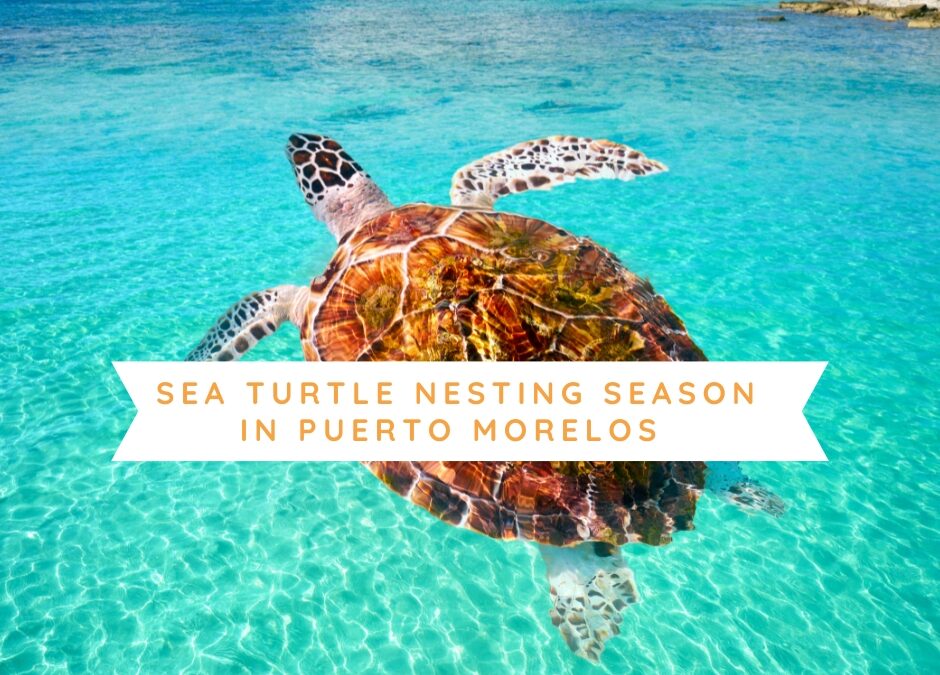
Sea Turtle Nesting Season Is Here in Puerto Morelos! All told, the season runs from May to November. Peak egg laying season is May-September, which means hatching season takes place July-November.
Sea turtles are nesting along our beaches, and this year we’ve seen more nesting activity than usual, including in some of our busiest beach areas. We all play an important role in helping protect these incredible animals.
If you spot sea turtle tracks, a nest, or a turtle in need of help, please report it right away so trained staff can respond and protect the nest if needed. Report It Immediately via WhatsApp +52-998-148-2111 Your report helps more baby sea turtles make it safely to the sea.
While you’re enjoying the beach, please remember:
- Remove chairs, umbrellas, toys, and other items from the sand when you leave so turtles have a clear path to nest and hatchlings can safely reach the ocean.
- Do Not Step on Turtle Tracks. This helps professionals to locate nests.
- Do Not Approach Nests. They are protected. Leave them undisturbed.
- Keep Pets Away. They can frighten sea turtles or damage nests.
- Do not leave trash or objects on the sand.
- Do Not Use Lights. Turn off or avoid using lights on the beach. Artificial lights can disorient sea turtles.
Thank you for doing your part to help keep Puerto Morelos a safe place for sea turtles. Every small action makes a difference!


Here’s the English translation of this post by the Puerto Morelos Reef National Park:
“A GOOD INTENTION CAN ALSO PUT THEM AT RISK
This year, we are experiencing an unusual situation on the beaches of Puerto Morelos: sea turtles have been nesting in an area where we previously did not have nests.
There is a sargassum containment barrier installed offshore from this beach. This structure does not pose a problem for female turtles when they come ashore to nest, but it can present a serious risk to hatchlings when they enter the sea, as they can become trapped and unable to continue toward open water.
For this reason, a few days before the estimated hatching date, we place protective enclosures around nests located in this area. This prevents the hatchlings from heading directly toward the barrier and allows us to collect them once they emerge and safely release them at a location free of obstacles.
These nests are checked two or three times a day, and the enclosures display a phone number so that anyone who sees hatchlings can notify us.
However, we need to ask you something VERY IMPORTANT:
PLEASE DO NOT RELEASE THE HATCHLINGS ON YOUR OWN.
Although we know the intention is to help, opening the enclosure and releasing the hatchlings directly into the sea can put them in danger.
Recently, this is exactly what happened. Someone found hatchlings inside one of the enclosures and decided to release them directly into the sea. As a result, the hatchlings headed toward the sargassum barrier and became trapped.
Park rangers were able to rescue 31 hatchlings found at the barrier and four that were still inside the nest. However, 107 hatchlings had emerged from the nest. Later, dead hatchlings began washing up on the beach.
We cannot say with certainty that all of the missing hatchlings died as a result of this incident, but what happened reminds us just how delicate this process is and how important it is for hatchlings to be handled properly.
If you find hatchlings inside one of these enclosures:
DO NOT touch them.
DO NOT open the enclosure.
DO NOT release them into the sea.
Call the number on the sign (+52 998 148 2111) or 911 and report it.
Wait for the appropriate personnel to arrive.
We follow these procedures for a very specific reason: to give the hatchlings the opportunity to reach the sea without encountering this barrier.
Sea turtle conservation is a shared responsibility. Sometimes, the best way to help is not to intervene, but to notify the people who know how to handle the situation properly.
Please help us by sharing this information.
If you see sea turtle hatchlings inside one of these enclosures, REPORT IT. DO NOT RELEASE THEM.
Every hatchling counts.
